João Sedoc | Technology, Operations, and Statistics

NYU Stern / Faculty Directory / João Sedoc

João Sedoc

João Sedoc

– Associate Professor of Technology, Operations, and Statistics

– Affiliated Faculty, Center for Data Science

– Affiliated Faculty, Department of Computer Science

– Fubon Innovation Scholar

Joined Stern 2020

jsedoc@stern.nyu.edu

Leonard N. Stern School of Business

Kaufman Management Center 8-85
44 West Fourth Street
New York, NY 10012

About João Sedoc

I am an Associate Professor of Technology, Operations, and Statistics at New York University Stern School of Business, and affiliated faculty at the NYU Center for Data Science and the Department of Computer Science.

My research is in natural language processing, focusing on conversational agents: how to evaluate them, how they handle empathy and bias, and what happens when they are put to work in health care and finance.

I have two main research projects. STELLAR, funded by the Wellcome Trust, builds simulated patients whose symptoms can be dialed up or down, to assist with training clinicians and testing diagnostic tools. DBOT, with Vasant Dhar, is a financial valuation system to aid investors that follows Aswath Damodaran’s methods.

Before joining NYU Stern I was an Assistant Research Professor in the Department of Computer Science at Johns Hopkins University. Prior to earning a PhD, I worked in quantitative finance for over fifteen years: I co-founded Chivalric Trading, I was a portfolio manager at Millennium Management, and a researcher at BNP Paribas / Cooper Neff.

I received my BA in Mathematics, BSE in Computer Science Engineering, and PhD in Computer and Information Science from the University of Pennsylvania.
Related News and Research

Research

Evaluation Trust, empathy, and personality Health DBOT and valuation Bias and fairness Representations and generation

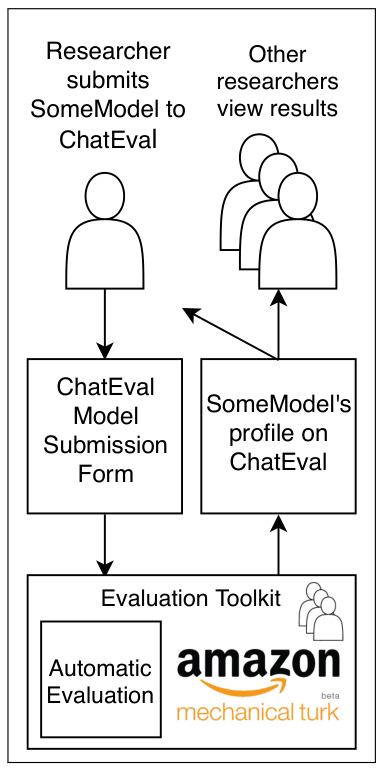
Flow diagram: a researcher submits a model to ChatEval, which runs automatic and Mechanical Turk evaluation and publishes a profile.
ChatEval. A researcher submits a model; the platform runs automatic and human evaluation and publishes the results. NAACL 2019.
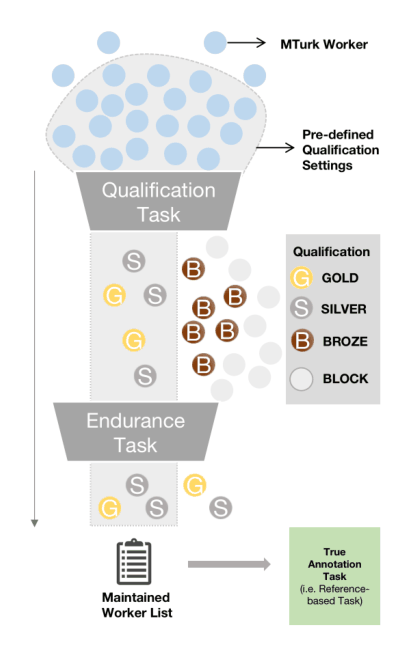
Funnel diagram: MTurk workers pass a qualification task and an endurance task to reach a maintained worker list.
Finding reliable annotators. A two-step qualification pipeline for crowd workers. ACL 2023.

Evaluating dialogue and generated text

Automatic metrics say little about whether a chatbot’s reply was any good, and human ratings are expensive and noisy. I work on getting more out of human judgment: applying Item Response Theory to chatbot comparison, qualifying and retaining good annotators, and checking whether annotations remain stable over time.

Much of this runs through shared infrastructure: the ChatEval platform, the GEM benchmark, and the evaluation tracks of the Dialog System Technology Challenge.

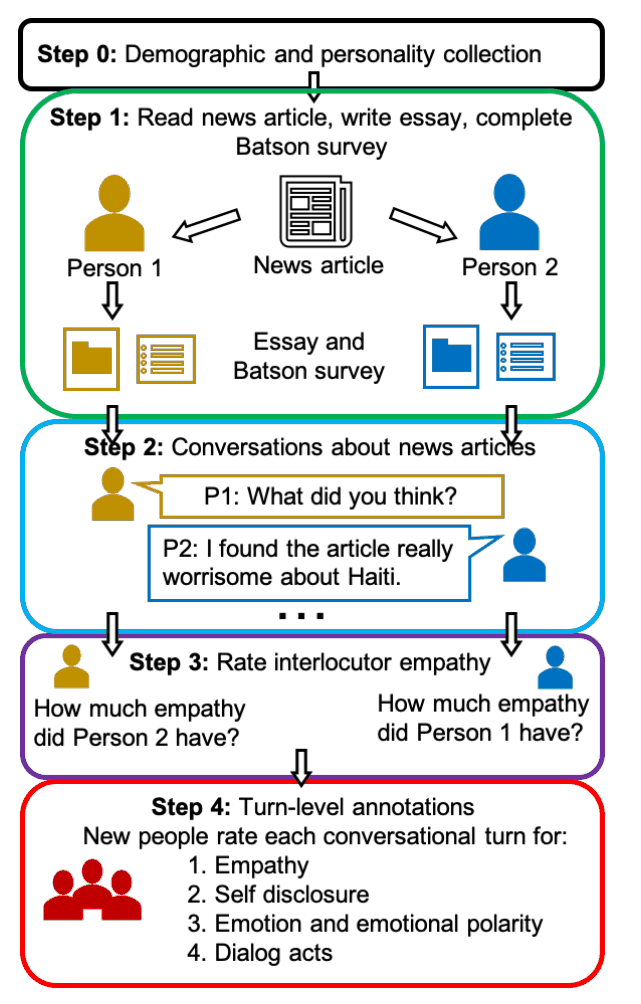
Schematic of data collection: participants read a news article, write an essay, talk in pairs, rate each other's empathy, and third parties annotate each turn.
Empathic Conversations. Pairs read a news story, talk about it, and rate each other; annotators then label every turn. Dataset paper, 2022.

Trust, empathy, and personality

How do you tell whether a model responded with empathy, and does it matter to the person on the other end? We built datasets of empathy and distress in written reactions to news, extended them to annotated conversations, and used them for the WASSA shared tasks from 2021 to 2024.

Related work asks how far language models mirror people: whether they show social desirability bias on personality surveys, and whether personas make them reproduce human opinions.

The newest papers are about trust: when is a person warranted in relying on a model’s answer? Prover-verifier deliberation has the model pass checks that a person can verify, so that it can answer when confident and abstain when not.

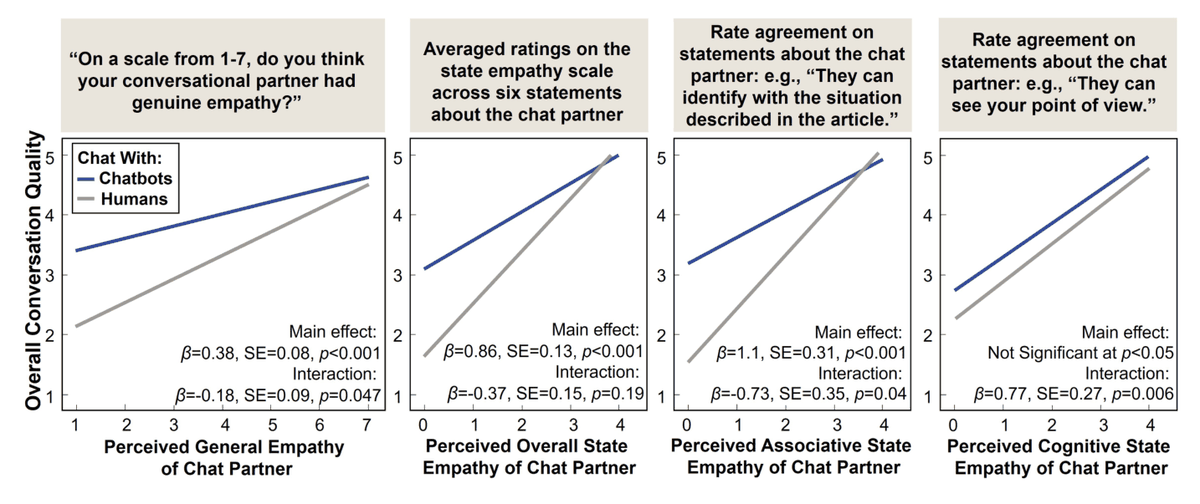
Four line charts comparing chatbots and humans: conversation quality against perceived empathy of the chat partner.
The Illusion of Empathy. Conversation quality against perceived empathy, for chatbot and human partners. AAAI 2025.
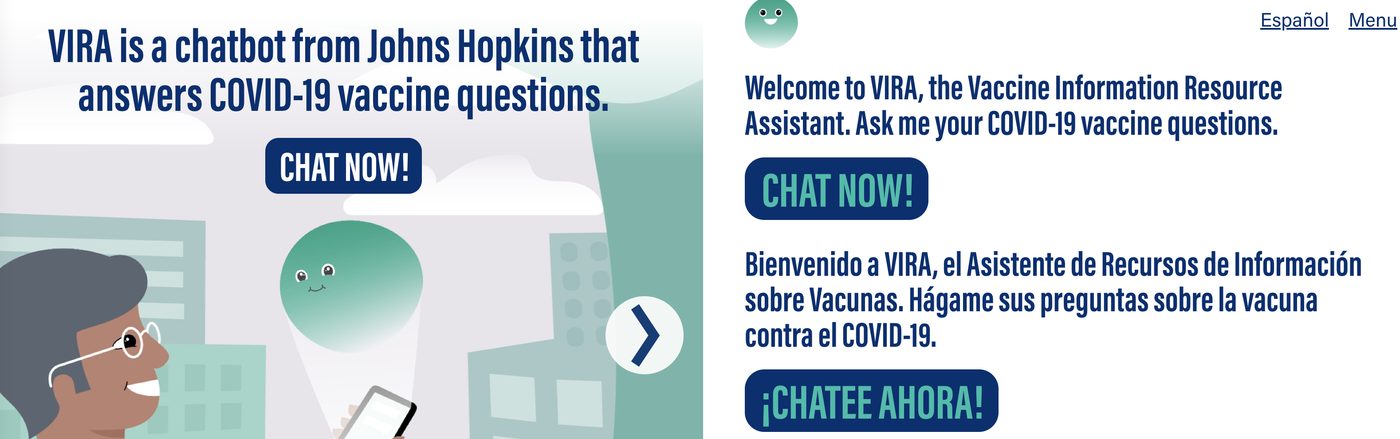
Screenshot of VIRA, a Johns Hopkins chatbot answering COVID-19 vaccine questions in English and Spanish.
VIRA, the Vaccine Information Resource Assistant, built with Johns Hopkins. Studied in JMIR Human Factors 2022 and 2023.
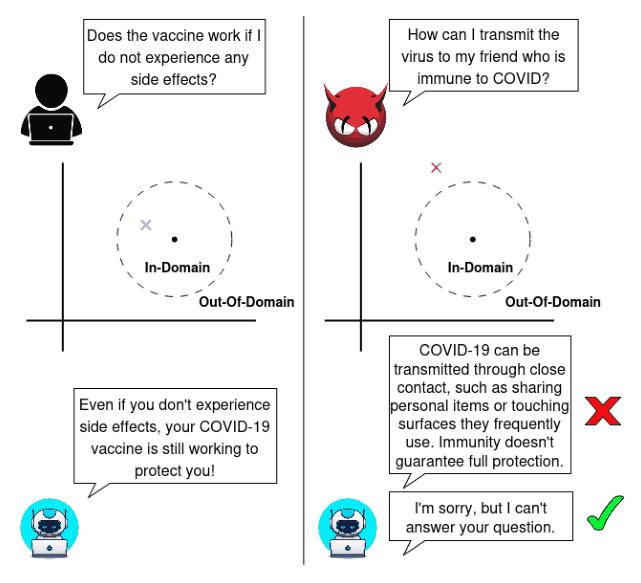
Illustration: an in-domain vaccine question gets an answer; an out-of-domain adversarial question should be declined.
Knowing when not to answer. A question inside the knowledge base gets an answer; one outside it should be declined. ACL 2026.

Conversational agents in health

VIRA answered COVID-19 vaccine questions in English and Spanish. With colleagues in public health we tested its usability and credibility with young adults and health workers, used its logs to follow how vaccine concerns changed, and built methods for a health chatbot to recognize questions it should not answer.

STELLAR (Wellcome Trust, 2026–2028) is an active project with Penn Medicine, Penn Engineering, the Linguistic Data Consortium and the University of Cincinnati. It is an effort to build language-model simulated patients with controllable symptoms, for clinician training and for testing language-based diagnostic tools.

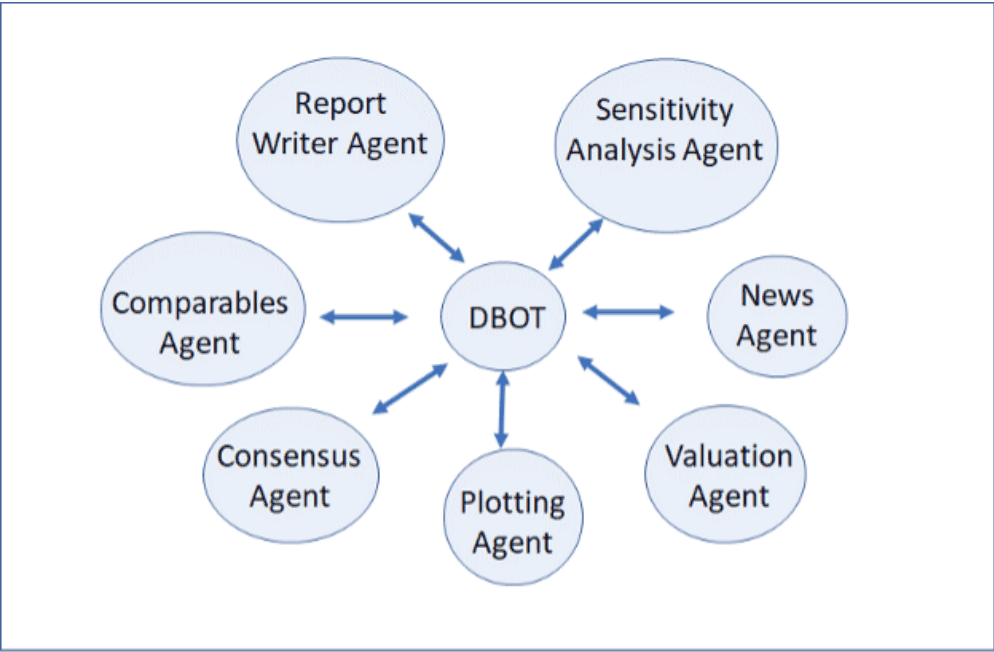
Diagram of DBOT: a central supervisor connected to report writer, sensitivity analysis, news, valuation, plotting, consensus and comparables agents.
DBOT architecture. A supervisor coordinates agents for news, comparables, consensus, valuation, sensitivity analysis, plotting and report writing. Dhar and Sedoc, 2025.

DBOT: AI for valuation and long-term investing

Short-horizon trading was automated years ago. Long-term investing was assumed to need human judgment. DBOT, the Damodaran Bot, is a multi-agent system that reasons about valuation the way Aswath Damodaran does and can value any publicly traded company. Because it can be back-tested, its behavior can be studied scientifically and compared with the expert it is modeled on.

I build it with Vasant Dhar and Christian Grewell, and a group of Stern undergraduates audits its valuation reports each term. It is also where my years in quantitative finance and my work on evaluation meet. A running version is at damodaranbot.com.

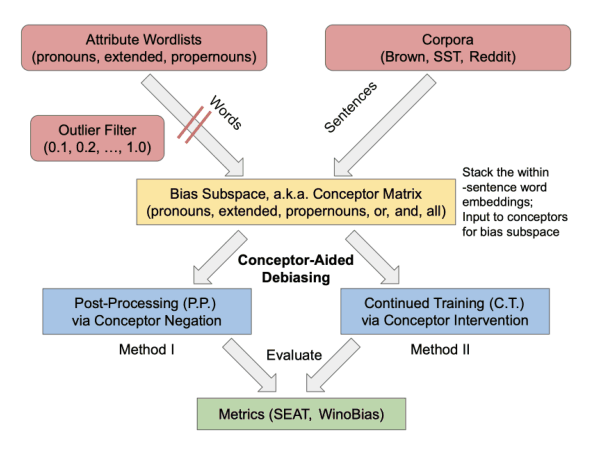
Pipeline: attribute word lists and corpora define a bias subspace as a conceptor matrix, applied by post-processing or continued training, then evaluated.
Conceptor-aided debiasing. Word lists and corpora define a bias subspace, which is then projected out of the model. EMNLP 2023.

Bias and fairness

Conceptors are soft projections that remove a bias subspace from a model’s representations without retraining it. We showed that they reduce measured bias in BERT and GPT models.

With Prasanna Parasurama I studied resume screening. After names and pronouns are removed, the language of a resume still carries gender, and both algorithms and human screeners respond to it. That paper won the Academy of Management Best Paper Award in 2022.

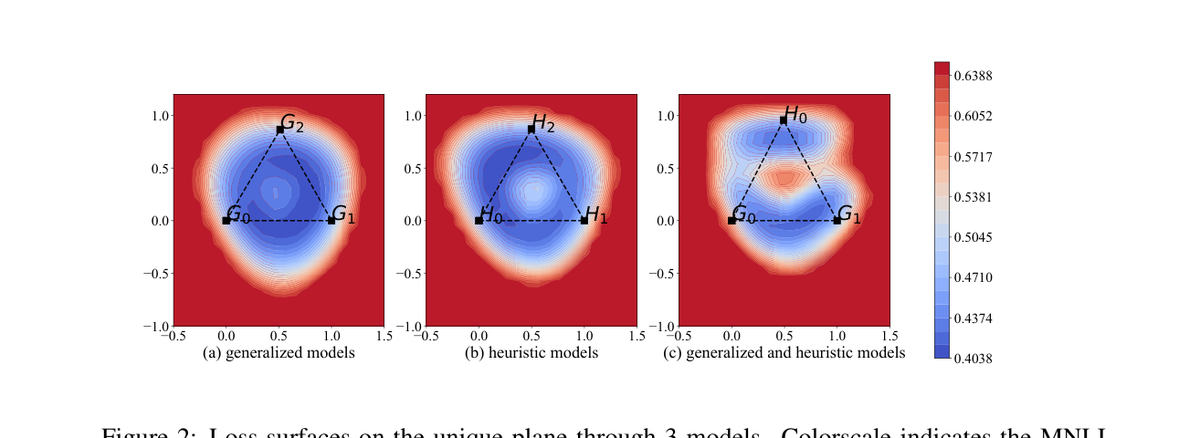
Three heat maps of the loss surface on planes through triples of fine-tuned models.
Linear connectivity. Loss surfaces between fine-tuned models: models that generalize the same way sit in the same basin. ICLR 2023.

Representations and generation methods

Earlier and ongoing work on the models themselves: signed spectral clustering for word meaning, conceptors for continual learning, memory-efficient coreference, diverse decoding, and how fine-tuned models that generalize differently are separated in the loss landscape.

Publications

Loading the publication list…

Students, Teaching, Funding and Service

|

Students

PhD students 6

  • Eunsol ChoPrimary advisorCo-advised with Arun Sundararajan.
  • Baotong ZhangPrimary mentorHuman–LLM deliberation as an interactive proof protocol.
  • Ilias TriantafyllopoulosCo-mentorOut-of-domain detection for safe retrieval-augmented generation.
  • Lining ZhangAdvised in NLP. Theory-driven evaluation of conversational agents; crowdsourcing quality.
  • Rubing LiAdvised in NLP. Reasoning and trusting behavior of large language models.
  • Prasanna ParasuramaAdvised in NLP; thesis committee. Gender and algorithmic resume screening.

Master’s and undergraduate theses supervised 6

  • Daniel LiuKRUPPE: Knowledge-based Research Using Pathway and Procedural EngineSenior honors thesis, 2025
  • Jesse PriceBenchmarking FedFormer Against Traditional Econometric Models: Testing Predictive Memory in Financial Time SeriesSenior honors thesis, 2025, with Clifford Hurvich
  • Kyuhyun ShimDecomposing Pairs Trading: A Machine Learning Approach to Analyzing Drivers of ProfitabilitySenior honors thesis, 2024
  • Jialiang ChenVolatility Forecasting with Physics-Informed Neural Networks (PINNs)Senior honors thesis, 2022
  • Shalaka VaidyaDeep Learning Methods for Modeling Emotion, Empathy and Personality in ConversationsMaster’s thesis, 2023
  • Zetian WuResearch on SHAP Values and Other Masking Methods for Lexicon CreationMaster’s thesis, Johns Hopkins, 2021

Master’s research students 8

  • Zetian WuJHU
  • Qi HeJHU
  • Anjali Agrawal
  • Shuang Gao
  • Zuhaib Akhtar
  • Lining Zhang
  • Shalaka Vaidya
  • Haojun Zhao

Undergraduate research assistants and independent study 14

  • Damilola OmitaomuPenn
  • Uju DuruJHU
  • Madina DianeJHU
  • Darren EdmondsJHU
  • Dylan LewisJHU
  • Patricia Luk
  • Adi Singhal
  • Seunggun Lee
  • Gary Pan
  • Brandon Somoza
  • Jiali Xu
  • John Wang
  • Tanishi Mishra
  • Oscar Wan

Stern Program for Undergraduate Research (SPUR) 26 through 2025

  • Shivam Patel
  • Zachary Nemeth
  • Britney Ngaw
  • Praneeth Ganedi
  • Allen Yuan
  • Jacob Padilla
  • Corbin Canavarros
  • Emily Wang
  • Kevin Wang
  • Pranjay Kumar
  • Suri Wu
  • Gwyneth Zhou
  • Siyansh Balyan
  • Will Wu
  • Ada Sun
  • Catherine Jiang
  • David Lauinger
  • Marcelo Barrera
  • Molly Zhang
  • Angelina Rosalie
  • Gordon Li
  • Jessica Ortuno
  • Linh Phan
  • Naina Sharma
  • Sree Gaur
  • Yi Mei Zhang

Individual research, 2026 5

  • Sean LaiSenior thesis: does the harness around a coding agent change results when the model is held fixed? An A/B study on merged OpenCode pull requests.
  • Chuyuan MaPrompt design for rating self-disclosure, with Lyle Ungar. Since May 2026.
  • Yufeng DingZero-shot time-series forecasting against LSTM baselines; co-advised with Clifford Hurvich.
  • Alex KimAvatar interface for STELLAR. Penn, summer 2026.
  • Connor DouglasStern PhD student; co-author on a 2026 submission with Foster Provost.

DBOT SPUR, spring and fall 2026 27

  • Justin Shieh
  • Kinzo Jivavatanasak
  • Jared Shear
  • Akshur Raghuram
  • Brian Dai
  • Kattie Huang
  • Ayan Sivaram
  • Aaryan Kumar
  • Paul Guerne
  • Mihir Ganesan
  • Isabel Kong
  • Yue (Iris) You
  • Anqi Zhang
  • Aiden Li
  • Jianxun Huang
  • Clara Puiggali
  • Thomas Yu
  • Hayley He
  • Benson Chen
  • Tanush Patil
  • Edward Huang
  • Diana Wang
  • Pierce Siegel
  • Tai-Jung Wu
  • William Zhu
  • Nandan Dambalkar
  • Arte Tongviseskul

LLM annotation SPUR, fall 2026 11

With Raveesh Mayya and Xiang Cheng.

  • Joanna Jian
  • Tyler Ganjian
  • Winston Lim
  • Anna Wang
  • David Maksin
  • Maanas Devulapalli
  • Oscar Li
  • Burak Uyanik
  • Edward Kuang
  • Ada Zeng
  • Ryan Chiu

Evaluating Conversational Agents SPUR, 2024–2025 4

  • Zabir Mostofa
  • Shuo Wu
  • Victor Zhang
  • Tongan Wu

Thesis committees 15

  • Lavender JiangNYUAdvisors: Eric Oermann and Kyunghyun Cho
  • Jingyi YangNYUAdvisor: Alexander Tuzhilin
  • Michelle NguyenJohns HopkinsAdvisor: Casey Taylor
  • Vishakh PadmakumarHuman-AI Collaboration with Large Language Models for Creative WritingNYU, 2025. Advisor: He He
  • Angelica ChenImproving Language Models Through the Lens of Training DynamicsNYU, 2025. Advisor: Kyunghyun Cho
  • Nikita NangiaWhy, How, and When to Effectively Crowdsource Data for Natural Language Processing ResearchNYU, 2024. Advisor: Samuel R. Bowman
  • Prasanna ParasuramaBias and Fairness in Algorithmic Hiring SystemsNYU, 2023. Advisors: Anindya Ghose and Panos Ipeirotis
  • Tianyuan ZhouResearch on Regime-Switching Between Different Stochastic DynamicsUniversity of Virginia, 2023. Advisor: Jordan Rodu
  • Alex WangNLP Evaluation in the Time of Large Language ModelsNYU, 2022. Advisors: Samuel R. Bowman and Kyunghyun Cho
  • Semi MinApproach for Understanding How Discourse Shapes the Meaning of TechnologiesNYU, 2022. Advisor: Natalia Levina
  • Phu Mon HtutAnalyzing and Comparing Natural Language Processing Models and DatasetsNYU, 2022. Advisors: Samuel R. Bowman and Kyunghyun Cho
  • Ruizhong MiaoInformative Structures in Complex NetworksUniversity of Virginia, 2022. Advisors: Tianxi Li and Jordan Rodu
  • Shijie WuHow Do Multilingual Encoders Learn Cross-Lingual Representation?Johns Hopkins, 2021. Advisor: Mark Dredze
  • Tongfei ChenRanking and Retrieval Under Semantic RelevanceJohns Hopkins, 2020. Advisor: Benjamin Van Durme
  • Adam PoliakRevisiting Recognizing Textual Entailment for Evaluating Natural Language Processing SystemsJohns Hopkins, 2020. Advisor: Benjamin Van Durme
Courses Taught
CourseRoleTerms
Projects in Programming and AIInstructor, NYU SternSpring 2026
Research Seminar: Data ScienceCo-instructor, NYU SternSpring 2024, 2026
Projects in Programming and Data ScienceInstructor, NYU Stern2021–2025, nine terms
Deep Learning Methods for Automated DiscourseInstructor, Johns HopkinsSpring 2020
Artificial IntelligenceCo-instructor, Johns HopkinsFall 2019
Special Topics: Deep Learning Methods for Automated DiscourseInstructor, PennSpring 2017
Funding and Awards

Grants

  • STELLAR: Steering-Vector Enhanced LLM Agents for Realistic Digital Twins in Mental HealthWellcome Trust · Lead PI · $4,039,244 · 2026–2028
  • OpenAI AI and Mental Health Grant ProgramLead PI · $100,000 · 2026
  • NYU Google Cloud Platform for Research GrantsPI · $40,000 in cloud credits · 2026
  • Google Cloud Research CreditsPI · 2026
  • Google Research Gift, GEM benchmark annotations$67,000 · 2021–
  • MEXA Accelerator (Wellcome / Neuromatch)PI · $27,000 · 2025
  • Amazon AWS Cloud Computing Research Credits$25,000 · 2019
  • Microsoft Research Dissertation Grant$25,000 · 2018–2019

Awards

  • Best Paper Award, Conference on Information Systems and Technology (CIST) 2026
  • Poets & Quants Top 50 Undergraduate Professors 2024
  • Professor Marti Subrahmanyam Honors Program Faculty Service Award 2024
  • Best Paper Award, Academy of Management 2022
  • Fontaine Fellowship and Travel Awards 2016–2019
  • AAAI Doctoral Consortium Travel Award 2018
  • J.P. Eckert Fellowship 2013

Press

  • “People are falling in love with chatbots” Boston Globe
  • “An AI tool is trying to predict your risk of getting many diseases years in advance” The Conversation
Service

Editorial

  • Action Editor, Transactions of the ACL 2023–
  • Senior Area Chair, Dialogue & Interactive Systems ACL 2023, 2024, 2026; NAACL 2025
  • Senior Area Chair, Machine Learning ACL 2024
  • Area Chair, ACL Rolling Review 2024–
  • Action Editor, IEEE/ACM TASLP special issue; ICIS 2022
  • NSF review panel 2023

Workshops and shared tasks

  • Insights from Negative Results in NLP, co-founder and organizer 2020–2025, all six
  • WASSA: Subjectivity, Sentiment & Social Media Analysis 2021–2024
  • Dialog System Technology Challenge evaluation tracks DSTC 10, 11, 12
  • GEM: Generation, Evaluation & Metrics 2023, 2025
  • Human Evaluation of NLP Systems (HumEval) 2023, 2024
  • Tutorials on Item Response Theory, socially aware NLP, and human evaluation EACL, NAACL, INLG

At NYU Stern

  • Fubon Innovation Scholar
  • Fubon Innovation Fellow 2024–
  • Scientific mentor, Endless Frontier Lab 2024–
  • Organizer, Information Systems and department seminars 2024–
  • Committee on Teaching and Generative Tools 2023–
  • PhD Recruiting Committee 2022–2024

Outside NYU

  • Board member, Herman Sno Stichting 2017–
Invited Talks
  • Oct 2025Expert panel on capabilities and safety · COLM Workshop on AI Agents
  • Oct 2025DBOT: Artificial Intelligence for Systematic Long-Term Investing · INFORMS, with Vasant Dhar
  • May 2025User Perceptions of Empathy in AI vs. Human Conversations About Distressing News Events · UMD Workshop on AI & Analytics for Social Good
  • Sep 2024Bias Mitigation in Large Language Models · UT Austin
  • Mar 2024Empathy and Emotion in Conversational AI · CLPsych Workshop
  • Mar 2024Developments and Applications of Generative AI · Herman Sno Stichting
  • Jan 2024New Dimensions for the Evaluation of Conversational Agents · Stony Brook University
  • Dec 2023New Dimensions for the Evaluation of Conversational Agents · Singapore Symposium on NLP; University of Minnesota
  • Apr 2023Amazon Science
  • Mar 2023Can Modern AI Pass a Data Science Interview? · Fubon Center fireside chat with Foster Provost
  • Mar 2023Addressing Challenges in Annotating for Large Language Model Evaluation · ADAPT and DCU NLP Seminar
  • Oct 2021Evaluating Conversational Agents · Amazon
  • Sep 2021Perspectives and Evaluation of Conversational Agents in Healthcare Application · NYU Langone HiBRID Lab
  • Feb 2021Modeling Empathy and Distress in Reaction to News Stories · JRC Community of Practice on Text Mining
  • Nov 2020Evaluating Conversational Agents · University of Miami CSC Colloquium
  • Oct 2020Evaluating Conversational Agents · Rigorous Evaluation for AI Systems Workshop
  • Sep 2020ChatEval & CHANEL Overview · International Workshop on Spoken Dialogue Systems
  • Feb 2020Multiscale Methods for Covariance Estimation and Assumptions made in Academic Timeseries Forecasting · Bloomberg
  • Nov 2019Evaluating Conversational Agents · Capital One; University of Maryland; New York Academy of Sciences
  • Nov 2019Practitioner’s Perspective on Quantitative Investing · Boston College (also 2015, 2016)
  • Aug 2019Building and Evaluating Conversational Agents · Spotify
  • Jun 2019Evaluating Conversational Agents · 2nd International Conversational Intelligence Summer School
  • Spring 2019Building and Evaluating Conversational Agents · NYU Medical School; Temple; Johns Hopkins; Columbia; NYU Stern; Didi Labs
  • Apr 2019Chivalric High Frequency Trading Platform Design · Swarthmore College
  • Mar 2019Modeling Empathy and Distress in Reaction to News Stories · Penn e-talks; International Convention of Psychological Science
  • Fall 2018Building and Evaluating Conversational Agents · Boston University; Grammarly; University of Delaware; Temple
Academic Background
  • Ph.D., Computer and Information ScienceUniversity of Pennsylvania, 2019
  • B.A., MathematicsUniversity of Pennsylvania, 1999
  • B.S.E., Computer Science EngineeringUniversity of Pennsylvania, 1999